Cloud Security Must Track Real Attack Paths

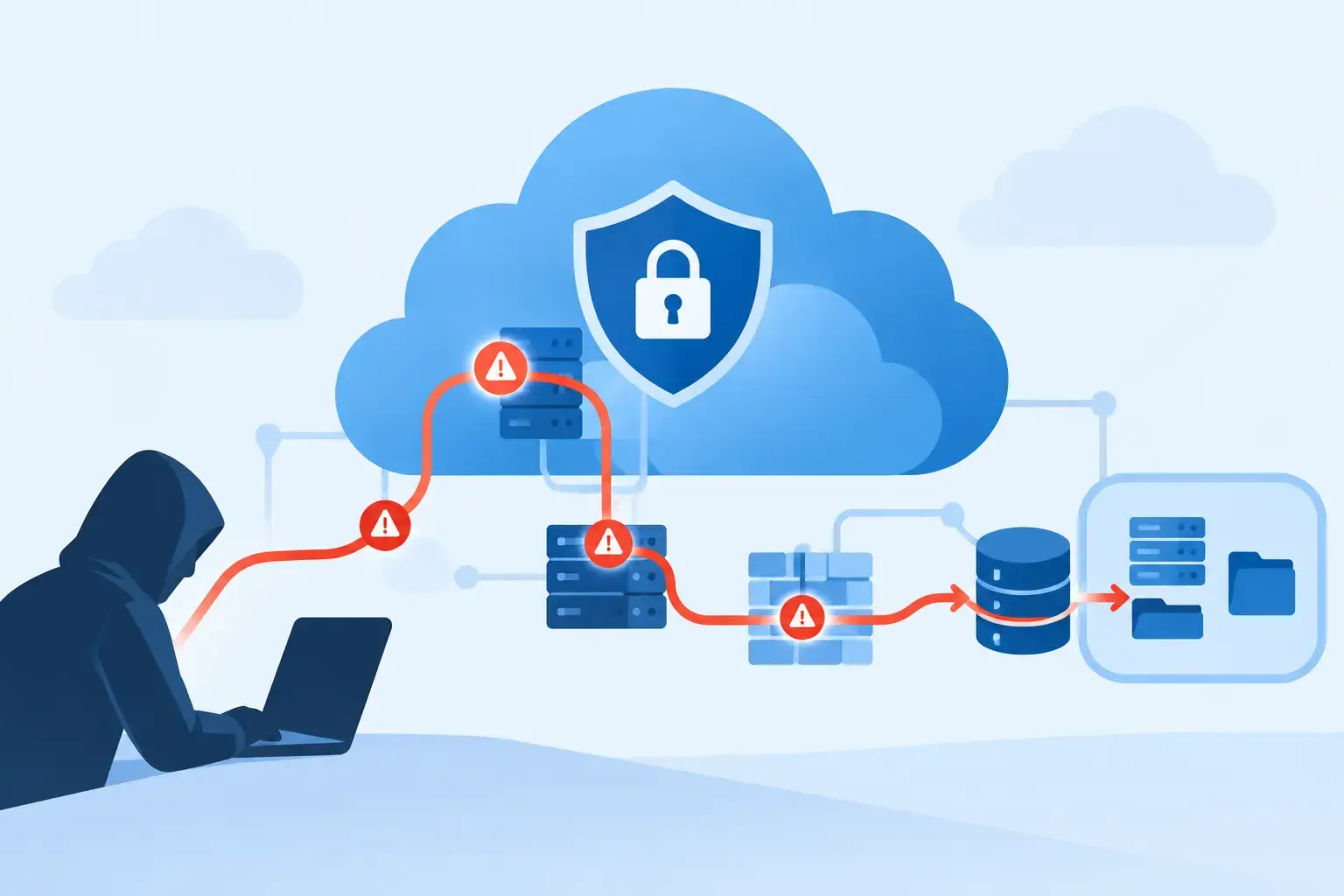
A public storage bucket is rarely the full incident. The real question is what an attacker can do next: use exposed data to target an employee, reuse a leaked credential, assume a privileged role, reach a production workload, or pivot into the identity plane. That is the standard cloud security programs must meet. Finding misconfigurations is useful. Proving which ones create a viable path to business-critical systems is what changes risk.
Enterprise cloud environments change faster than most security operating models. New accounts, subscriptions, projects, containers, service identities, SaaS integrations, AI-built applications, and remote access paths appear continuously. A quarterly review can document a moment that has already passed. An annual penetration test can demonstrate that a breach was possible, then leave the environment untested for the next eleven months.
Attackers do not wait for the assessment calendar. They work from what they can see, test exposed trust relationships, and exploit the gaps between cloud, identity, endpoint, and application teams. Cloud security needs to operate the same way: continuously, across the whole attack path, with remediation decisions tied to business impact.
Why Cloud Security Programs Miss Material Risk
Most teams do not lack security telemetry. They lack a reliable way to turn telemetry into decisions. Cloud-native posture tools, vulnerability scanners, identity platforms, ticketing systems, and SIEMs each produce useful signals. Together, they can also produce a backlog no team can realistically clear.
The problem is not simply alert volume. It is context loss. A scanner may flag a critical CVE on an internet-facing virtual machine, but it may not establish whether the workload is reachable, whether exploitation is practical, what credentials an attacker could obtain, or whether that system has a path to sensitive data. Conversely, a medium-severity identity permission may be the first step toward an administrator role in a production tenant.
CVSS alone cannot prioritize cloud exposure. Neither can a posture score. Security leaders need to know which finding changes the attacker’s position and which remediation closes the most dangerous route.
This becomes harder in hybrid enterprises. Cloud resources often trust on-premises identity infrastructure. CI/CD systems hold powerful tokens. Third-party integrations create persistent access. A developer may deploy an AI-generated application with broad permissions and a public endpoint before it reaches normal review. Each decision may be reasonable in isolation. Combined, they can create an attack path that no single tool sees clearly.
Start With What an Attacker Can Reach
A defensible program begins outside the perimeter. Inventory should not mean a spreadsheet of assets that were known last quarter. It should show what is currently exposed to the internet, who owns it, what cloud environment it belongs to, and what it can reach.
That includes obvious assets such as public web applications, VPN gateways, APIs, cloud load balancers, and remote administration services. It also includes the quieter exposure attackers actively seek: open object storage, abandoned DNS records, exposed development environments, source-code repositories, leaked keys, unmanaged SaaS tenants, and shadow cloud accounts.
External discovery is only the first layer. The next task is to correlate exposed assets with internal relationships. Can the application access a database? Does its workload identity have permission to read secrets? Can a developer token modify a deployment pipeline? Does that pipeline hold credentials for another environment? These questions turn isolated findings into attack-path analysis.
Identity Is the Cloud Control Plane
In cloud environments, identity is often more consequential than a missing patch. Privileged roles, stale service accounts, excessive federation trust, long-lived access keys, and weak conditional access policies can give an attacker durable control without exploiting a traditional software flaw.
Teams should examine effective permissions, not just assigned roles. Group nesting, inherited permissions, resource policies, cross-account trust, and OAuth grants frequently create authority that is invisible in a basic entitlement review. The relevant question is direct: if this identity is compromised, what actions can it take right now?
That analysis must cover humans and non-human identities. Service principals, workload identities, CI/CD runners, automation accounts, and API tokens commonly have broad privileges because operations depend on them. They are also attractive targets because they may lack phishing-resistant authentication, behavioral monitoring, or regular access review.
Validate Exploitability Before You Escalate
Continuous discovery without validation creates another noisy security program. Every finding does not deserve an emergency ticket. Mature teams test the conditions that determine whether an exposure is usable by an adversary.
For a public application, validation may mean confirming reachability, authentication behavior, vulnerable component usage, and access to downstream services. For exposed storage, it may mean determining whether data can actually be listed, read, written, or used to identify higher-value targets. For identity risk, it may mean mapping whether a permission chain allows privilege escalation or lateral movement.
This work requires both automation and human judgment. AI agents can enumerate assets, identify relationships, monitor changes, and test defined hypotheses at machine speed. Experienced operators are still needed to distinguish a theoretical route from a reliable compromise path, avoid unsafe testing, and interpret the business consequences of success.
That distinction matters to the remediation queue. A validated path from an exposed application to production secrets deserves immediate ownership. A low-impact configuration gap may belong in planned hardening. Treating both as equally urgent burns credibility with engineering teams and leaves the real route open longer.
Cloud Security Must Include the AI Attack Surface
Enterprise AI adoption has expanded the definition of cloud exposure. AI agents connect to internal tools, repositories, databases, ticketing platforms, and collaboration systems. MCP servers can expose new tool connections. Copilot extensions and custom assistants may inherit access from the users or service identities that invoke them. AI-built applications can reach production before their authorization model is understood.
Prompt injection changes the threat model because untrusted content can influence an agent’s decisions and tool use. A malicious document, webpage, email, or support ticket may attempt to redirect an agent from its intended task, extract sensitive context, or trigger unauthorized actions. Traditional cloud controls remain necessary, but they do not answer whether an agent can be manipulated into misusing legitimate access.
Security teams need telemetry for AI usage, discovery for unauthorized AI services and tool servers, and controls at the connection layer where agents invoke tools. They also need to test these systems like an adversary would. Can a prompt alter tool selection? Can an agent access more data than the requesting user should see? Can a connected tool execute a high-impact action without clear authorization or audit evidence?
The answer will vary by use case. A low-risk internal knowledge assistant should not be governed like an agent that can modify infrastructure or approve financial transactions. The control model should match the sensitivity of the data, the power of the connected tools, and the blast radius of failure.
Build One Action Plan, Not Another Dashboard
The operational output of cloud security should be a living action plan. Each item should connect an exposed asset or identity to exploitability, affected business services, likely attacker actions, remediation effort, accountable owner, and expected reduction in risk.
This is where prioritization becomes measurable. A team may choose to fix an exposed secret that enables production access before remediating dozens of isolated configuration findings. It may prioritize removing a cross-account trust relationship over a patch that has no reachable exploit path. These are not shortcuts. They are decisions based on return on remediation effort.
Effective programs also track exposure windows. How long did a public asset remain unknown? How quickly was an over-permissioned role corrected after discovery? Did a remediation actually break the attack path, or did an alternate route remain? Those measures show whether the organization is reducing exploitable exposure rather than merely closing tickets.
Armada applies this model by combining continuous external discovery, internal agentic testing, AI exposure coverage, and human-led validation into one prioritized remediation plan. The objective is not a larger finding count. It is fewer viable paths to critical systems.
Make Continuous Testing Part of Operations
Cloud security does not improve because the organization buys another scanner. It improves when discovery, validation, remediation, and retesting operate as a disciplined loop. Security teams need authority to prioritize risk. Engineering teams need clear, actionable evidence. Leadership needs proof that investment is closing the exposures an adversary would use.
Start with the attack paths that matter most: internet-facing entry points, identity escalation routes, production secrets, sensitive data stores, and AI agents connected to powerful tools. Assign owners, verify fixes, and reassess when the environment changes. The cloud will keep moving. Your security program should be built to move with it.

Part of the Armada team: CREST-accredited team members who run continuous exposure management and red teaming for our clients.